Table of Contents
Phoenix pending home sales just hit their lowest count since January 2009. Here's why referral-heavy contractors will feel it first, and the number to run this week.
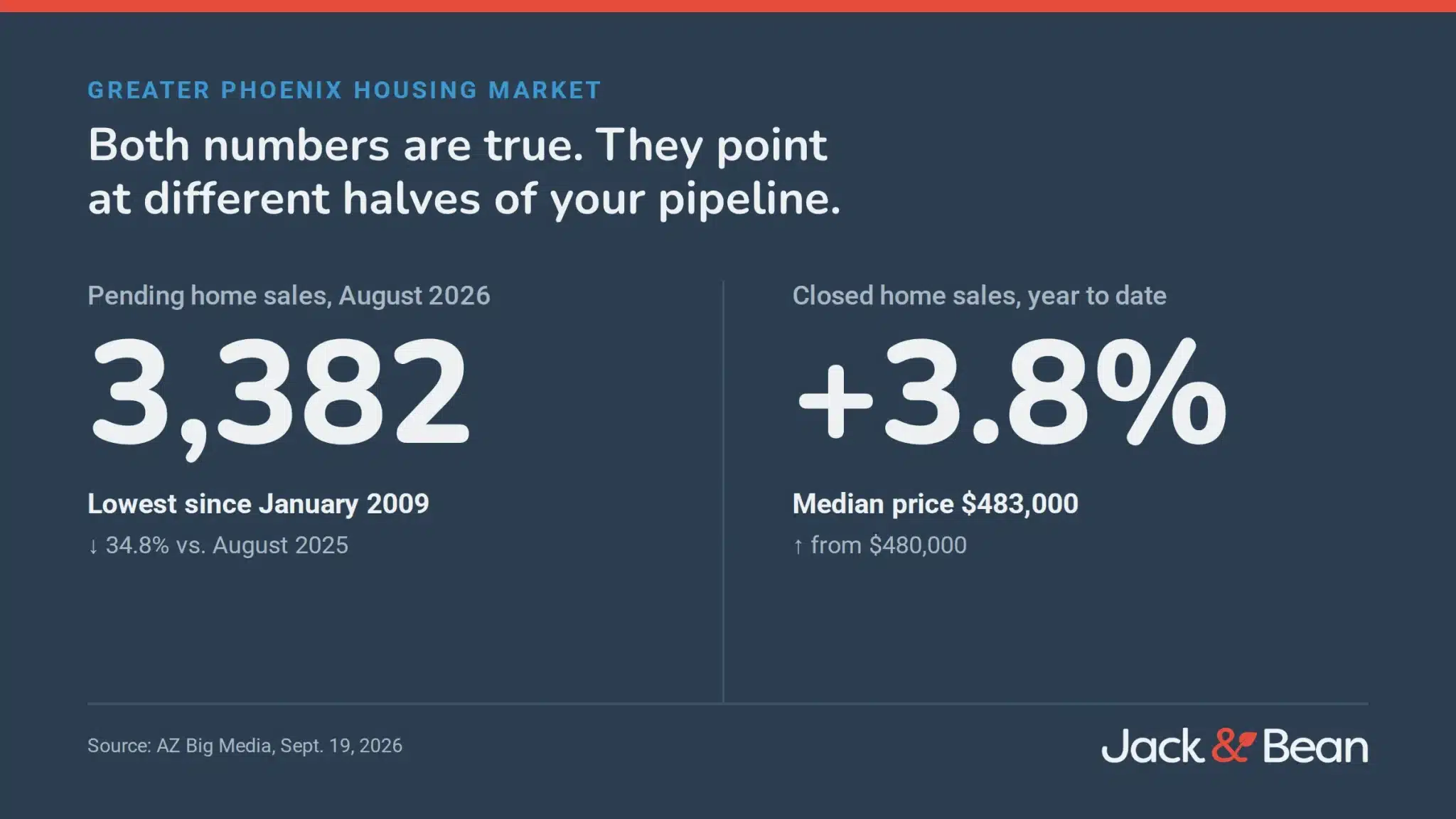
Greater Phoenix closed August with 3,382 pending home sales. That’s down 34.8% from August last year and the fewest pending contracts the metro has recorded since January 2009.
In the same report, year-to-date closed sales are up 3.8% and the median price is up to $483,000.
Both numbers are true. They point at different halves of your sales pipeline, and if you run an HVAC, plumbing, roofing, or remodeling business in the Valley, you need to know which half you depend on before fall shows you.
Two engines, not one
Home-service demand runs on two engines.
Transaction-triggered work starts because a house changes hands. The inspection report flags a water heater, or the seller fixes the roof before listing. This work arrives through realtors, inspectors, and the flurry of projects that follow a closing.
Tenure-triggered work starts because someone has lived in a house long enough for something to wear out. Nobody sold anything. The system just failed, or the owner finally decided to deal with it.
Most contractors never separate the two. Leads are leads. That works fine while both engines are running. It stops working the month one of them stalls.
Right now, the transaction engine is stalling
August’s pending-sales count is a forward indicator. Pending contracts are next month’s closings, and next month’s closings are the inspection repairs, pre-listing fixes, and new-owner projects of October and November.
The rest of the August data points the same direction:
- New listings down 9.2% compared to August last year
- Months of supply at 4.0, up from 3.9
- Days on market averaging 78 so far this year, up from 73 in 2025
Fewer houses are listing, the ones that do are sitting longer, and far fewer are going under contract. The houses aren’t going anywhere. Neither are the people in them, which is the part that matters to you.
Why referral-dependent contractors feel it first
If a meaningful share of your jobs comes from realtor referrals, home-inspection work, or new-owner projects, your lead flow is about to lag the market, and it will lag in a way that looks like a marketing problem.
Calls slow down and the phone gets quieter than last October. The instinct is to spend more, push harder on ads, or get back in front of every realtor you know.
But this is a mix problem – the work is still in the Valley. It’s sitting inside houses that aren’t changing hands, owned by people who are staying put and will spend money on the house they’re in. The AC or roof is still going to fail no matter who owns it.
What changes is how that work finds you. A homeowner who isn’t moving doesn’t meet you through a realtor. They find you on their own, usually weeks before they call, while they’re searching and researching whether to repair or replace, and who in their area actually does the work.
Reaching that homeowner is a different motion: showing up for non-emergency searches, keeping existing customers on maintenance plans, and publishing content that answers the question they’re asking before they’re ready to book.
If your fall plan is just “call more realtors,” you are fishing in a pond that is draining.
Run this number before you change anything
Before you touch a single ad, answer one question:
What share of last quarter’s jobs started with a house changing hands?
Pull your jobs from July through September. Mark every one that came from a realtor, an inspector, a pre-listing repair, or a customer who had owned the home less than a year. Divide by the total.
If that number is small, the August data is interesting background and not much more.
If it’s a quarter of your work or higher, you have a gap coming this fall, and it’s one you can see now instead of discovering in November. Rather than spending more to reach the same people, the fix is shifting where you show up so the homeowners who are staying put can find you first.
Source: AZ Big Media, “Metro Phoenix home sales gain momentum as fall approaches,” Sept. 19, 2026 – azbigmedia.com. All figures are Greater Phoenix unless noted.
About the Author: Jack Dorney